Most Indian companies think that going paperless has solved their paperwork problem. It didn’t. It solved the printing problem.
A CA firm in Mumbai still reviews every engagement letter by hand. An HR manager in Bangalore chases offer letter approvals across WhatsApp groups. A procurement team in Delhi discovers a vendor agreement auto-renews — three months after signing — because nobody caught the clause during a rushed Friday evening review.
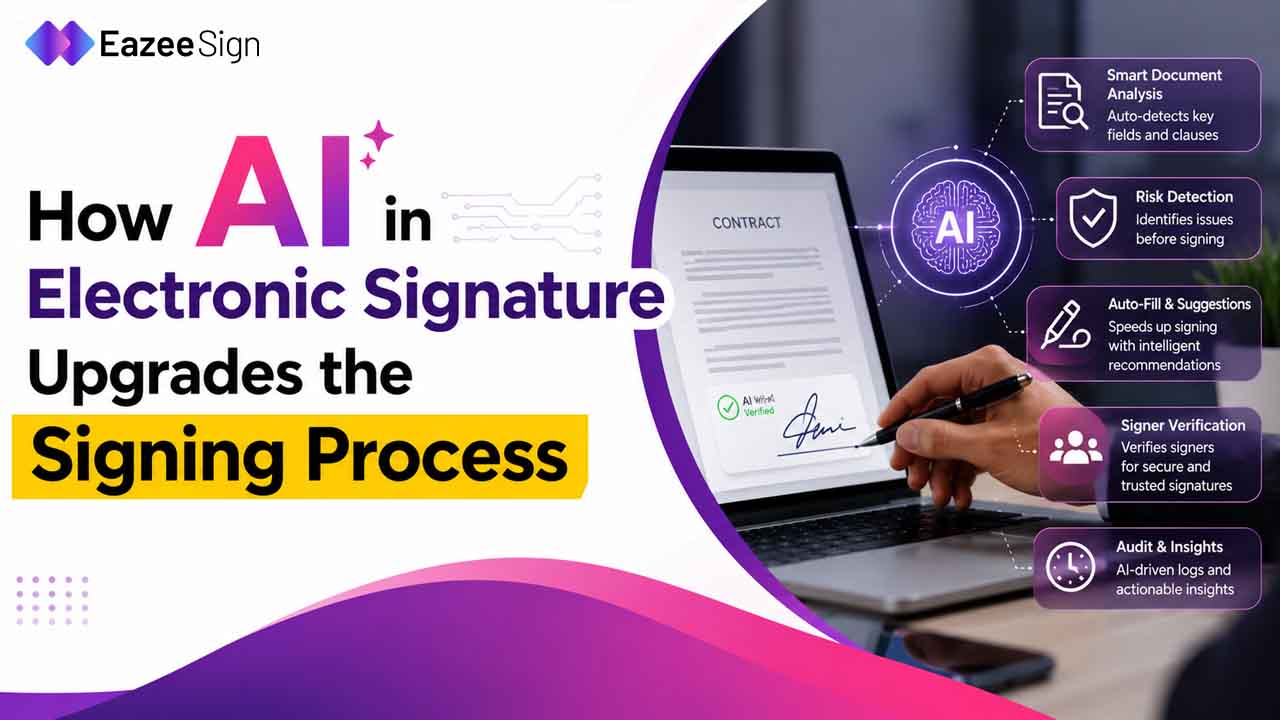
AI in electronic signature software is what finally closes those gaps. Not by replacing human judgment, but by removing the friction that makes good judgment hard to exercise in the middle of a workday that already has too many tabs open.
Here’s what that looks like for teams operating in India.
Common Problems Without AI in Electronic Signature
A sales head sends a master service agreement to a prospect in Singapore. The prospect in India eSigns in minutes through Aadhaar OTP. Everyone celebrates.
Then finance opens the same document two weeks later and finds a liability cap that was negotiated down in a side email but never made it into the final version. The Aadhaar eSign stands. The company eats the risk.
This isn’t rare. Manual document review, delayed approvals, missed clauses, and human error are the quiet tax on every “paperless” workflow. Electronic signatures moved the process online. They didn’t make it smart.
Different departments. Different timelines. Different inboxes. That’s where things break — especially when your signers are across cities, and your compliance team is trying to align with IT Act 2000 requirements while juggling ten other priorities.
What Changes After Adopting AI in eSignature
AI doesn’t just add features to eSign platforms. It changes the nature of what happens before the signature hits the page.
Think of it this way: traditional eSign software is a delivery system. AI turns it into a thinking partner — one that reads, flags, summarizes, and routes while you focus on the decision, not the document archaeology.
Here’s the thing. Most Indian teams don’t need faster signing. They need faster understanding — because in a market where deal velocity matters and regulatory scrutiny is only increasing, signing fast means nothing if you’re signing blind.
How AI in Electronic Signature Improves the Signing Process
AI Summarizes Long Documents in Seconds
A procurement lead receives a 60-page supplier contract on a Friday evening. Without AI, that contract sits unread until Monday, or gets skimmed in a rush, or gets forwarded to legal with a “please review” note that joins a queue of twenty others.
With AI summarization — a core feature of platforms like EazeeSign — the system extracts key terms into a structured overview in under 30 seconds. Payment schedules. Termination rights. Liability limits. The procurement lead knows what matters before the first cup of chai cools.
That’s not convenience. That’s risk management at the speed of Indian business.
AI Highlights Important Clauses Before You Sign
Not all contract language is created equal. Some clauses are routine. Others carry weight that only becomes visible in context — a governing law shift to a foreign jurisdiction, a data protection omission that conflicts with India’s Digital Personal Data Protection Act, an exclusivity term that wasn’t in your standard template.
AI clause extraction identifies these automatically. It maps contract language against known patterns, pulls out what deviates from standard playbooks, and surfaces it for human review. The signer still decides. But they decide with eyes open — and with the confidence that nothing critical got buried on page 37.
AI Detects Risks and Potential Red Flags
Risk detection goes a step further. It doesn’t just find clauses — it scores them.
An indemnification clause with no liability cap? High risk. A termination notice period shorter than company policy? Flagged. A non-standard governing law in a jurisdiction your legal team doesn’t typically accept? Highlighted immediately.
This is where AI in electronic signature moves from helpful to essential. According to industry benchmarks, inefficient contract processes can erode up to 9% of annual revenue due to unmanaged risk and delays. AI doesn’t eliminate that risk. It makes it visible before the Aadhaar eSign locks it in — and before your compliance team has to explain to the MCA why a problematic clause made it through.
AI Generates Documents with Simple Prompts
A startup founder in Hyderabad needs an NDA for a potential investor meeting in two hours. No legal team on retainer. No template library that isn’t five years old.
AI contract generation takes a plain-language prompt — “standard mutual NDA, 2-year term, governing law India” — and produces a ready-to-review document in minutes. It’s not a substitute for legal counsel on complex deals. For routine agreements, though, it removes the bottleneck that kills momentum in a funding environment where speed-to-close can make or break a round.
AI Compares Different Document Versions
Version confusion is a special kind of hell. The redlines from Tuesday. The “final final” from Wednesday. The one the client actually signed on Thursday, which was actually Monday’s draft with two manual edits nobody tracked.
AI document comparison highlights differences across versions automatically — clause by clause, word by word. No more guessing whether the liability cap made it into the executed copy. No more discovering discrepancies three months later when the dispute arises.
AI Automates Approval Workflows
Some documents need one signature. Others need three approvals, a legal review, and a finance checkpoint — in that exact order, with reminders when someone goes quiet for 48 hours.
AI workflow automation routes documents based on content, not just sender preference. A contract over a certain value triggers additional review. A clause flagged as high-risk pauses the workflow until legal clears it. The system remembers the rules so people don’t have to — and in a country where Aadhaar eSign workflows must comply with CCA approved Certifying Authority standards, that consistency matters.
Benefits of AI in Electronic Signature
Faster Document Turnaround
Contracts that sat in inboxes for days now move in hours. Not because people work harder — because the machine handles the routing, reminding, and preliminary review that used to consume mental bandwidth. For Indian businesses competing in fast-moving sectors, that velocity translates directly to closed deals and faster vendor onboarding.
Better Decision Making
When a signer sees a one-page summary instead of a forty-page document, they make sharper choices. When risk scores appear before the signature field, they sign with confidence instead of hope. In a regulatory environment where IT Act 2000 compliance and Aadhaar eSign validity are non-negotiable, that confidence is worth protecting.
Reduced Manual Work
Legal teams reviewing NDAs. Procurement teams checking supplier terms. HR teams verifying offer letter details. AI handles the first pass. Humans handle the exceptions. The math on time saved compounds quickly — especially for lean teams that can’t afford to hire a dedicated contract analyst for every function.
Improved Accuracy
Fatigue-driven errors — the missed auto-renewal, the wrong effective date, the copy-paste from an old template that still has the previous client’s name — drop significantly when AI checks before human eyes confirm. In India, where Aadhaar eSign carries presumptive validity under the Evidence Act, accuracy isn’t just about efficiency. It’s about enforceability.
Enhanced Compliance and Security
Modern AI eSign platforms capture full audit trails: timestamps, IP addresses, authentication steps, document fingerprints. They align with the IT Act 2000, Aadhaar eSign guidelines under UIDAI, and standards set by CCA approved Certifying Authorities. For Indian businesses handling sensitive data, this isn’t a nice-to-have — it’s the foundation of legal defensibility.
What to Look for in AI-Powered Electronic Signature Software
Not every platform that claims AI delivers the same depth. Here’s what separates the useful from the marketing gloss
| Feature |
What It Should Actually Do |
| AI Summary |
Extract key terms into plain-language overviews, not just keyword lists |
| Risk Detection |
Score deviations against your playbook, not generic “suspicious language” alerts |
| Clause Extraction |
Identify specific clause types — indemnity, termination, governing law — with context |
| Workflow Automation |
Route based on document content and rules, not just static sender settings |
| Security |
AES-256 encryption, TLS 1.3 in transit, tamper-evident seals, and role-based access |
| Audit Trail |
Complete metadata capture: who, what, when, from where, with what authentication |
| Integrations |
Native connections to your CRM, cloud storage, and document management systems |
For Indian businesses specifically, verify Aadhaar eSign integration, compliance with UIDAI and CCA guidelines, and data residency within India where required by regulatory frameworks.
Why Indian Businesses Are Choosing AI-Powered Electronic Signature Solutions
Businesses aren’t adopting AI-powered eSign because it’s new. They’re adopting it because the cost of not adopting it is becoming measurable.
Missed clauses that turn into disputes. Approval delays that turn into lost deals. Manual review queues that turn into hiring requests that strain budgets already stretched by GST compliance, MCA filings, and the daily operational complexity of running a business in India.
Then again, “worked” is a generous term for a process where a single missed auto-renewal can cost more than a year of platform fees.
EazeeSign builds these capabilities directly into the signing workflow — AI summaries, risk detection, clause extraction, contract generation, version comparison, and automated routing — without requiring teams to stitch together separate tools. Transparent pricing with no hidden charges. 24×7 dedicated support. Speed you can actually feel in daily work.
The goal isn’t to replace legal judgment or procurement expertise. It’s to let those experts spend their time on what actually requires expertise, instead of on document archaeology.
Conclusion
If your team signed a problematic contract last quarter, at what stage did the problem enter the document? During negotiation? During review? During the final sign-off when someone was rushing to close before the GST filing deadline?
Most of the time, the information was there. The time to absorb it wasn’t.
AI in electronic signature doesn’t promise perfect contracts. It promises that the humans making the decisions have a fighting chance to see what they’re deciding on — before the Aadhaar eSign makes it binding, before the MCA asks questions, and before the problem becomes a problem you can’t undo.