

B-1/E-23, Mohan Co-Operative Industrial Area, Mathura Road, Delhi-110044, India


- Electronic Signature
- 15-Jul-2026
- -
- 0 Comments
Most people think the signature is the most important part of a signed document — It isn’t, the audit trail is.
A signature tells you someone agreed to something. The audit trail tells you who, when, how, from where and whether anything changed afterward. That combination is what turns a signed document from a formality into something that actually holds up — in a dispute, a compliance audit, a regulatory inquiry, or a courtroom.
Understanding how audit trails work in electronic signature software isn’t just a technical exercise. It’s a business decision about how much protection your signed documents actually provide.
What is Audit Trail in Electronic Signature Software
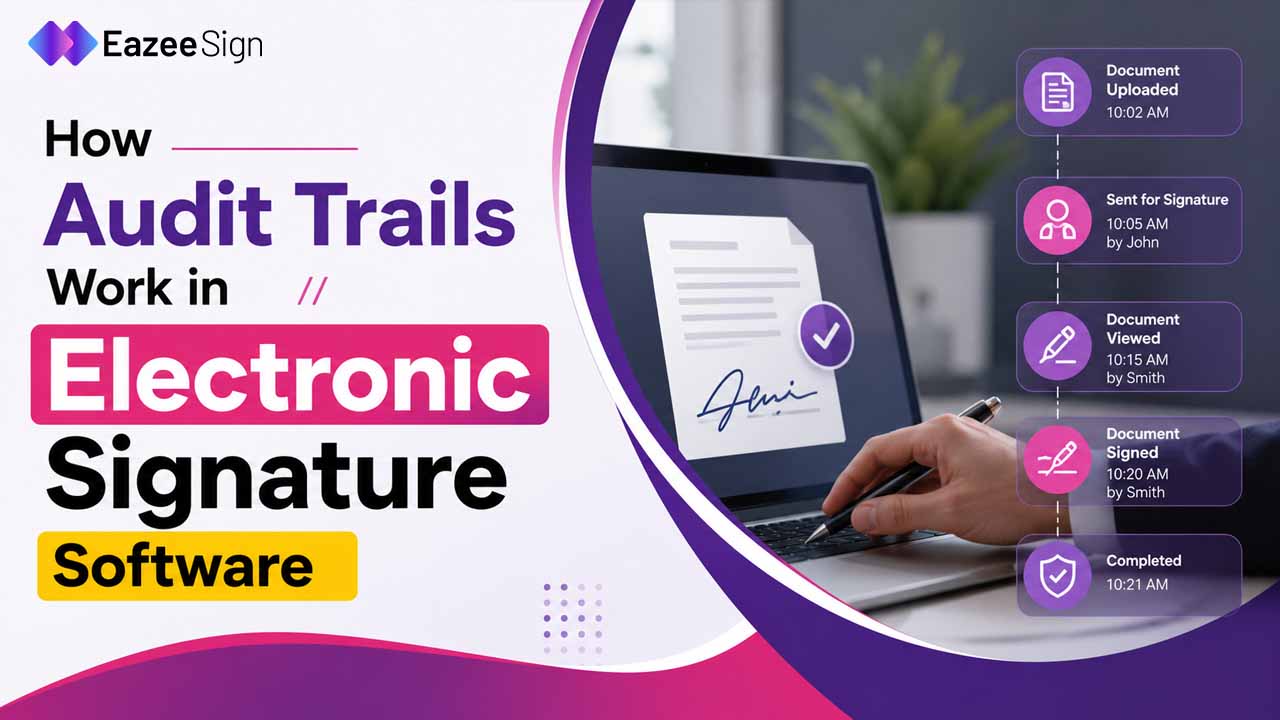
When the document was uploaded. When the signing invitation was sent. When each recipient opened it. When they reviewed it. When they signed — or declined. What device they used. Which IP address does the action come from. What authentication method confirmed their identity? And a cryptographic fingerprint of the document’s exact contents at the moment of signing.
That’s a comprehensive audit trail. Not a log file. Not a summary. A court-admissible, tamper-evident record that reconstructs the entire signing event without relying on anyone’s memory or inbox.
Why Electronic Signature Software Needs More Than Basic Logging
Here’s where platforms diverge significantly — and where most buyers don’t dig deep enough.
Basic electronic signature software logs who signed and when. That’s better than nothing. But it’s a surface-level record that leaves significant gaps when something is actually disputed.
A vendor claiming they signed under duress. A client insisting they never received the document. A counterparty arguing the terms were different from what they agreed to. In each of these situations, a log that says “signed at 3:42 pm on Tuesday” doesn’t resolve anything. It raises more questions than it answers.
A comprehensive audit trail resolves all of them.
It confirms the signer’s verified identity — not just their email address. It shows the document was opened and reviewed before signing — not just received. It captures the cryptographic state of the document at the exact moment of signing — meaning any subsequent change is immediately detectable. And it records the authentication method used, so there’s no question about how identity was confirmed.
That depth is what separates a useful record from a legally defensible one.
How Electronic Signature Software Generates an Audit Trail
The process runs automatically — no extra steps required from the sender or signer.
When a document is uploaded to a compliant electronic signature software platform, the system begins logging immediately. Every action from that point forward is captured in real time: document prepared, fields assigned, invitation sent, email delivered, link opened, pages scrolled, fields completed, signature applied.
At the moment of signing, two things happen simultaneously. The signer’s verified identity is recorded against their action. And a cryptographic hash — a unique mathematical fingerprint of the document’s exact contents — is generated and sealed. If even a single character in the document changes after that moment, the hash no longer matches and the tampering is immediately flagged.
That combination — identity record plus cryptographic document integrity — is what makes a digital signature software audit trail legally meaningful rather than just administratively useful.
The completed audit trail is attached to the signed document as a certificate of completion. It travels with the document and can be verified independently — without contacting the platform, without a third-party check. The math confirms it.
What a Complete Audit Trail Captures
Not all audit trails contain the same information. Here’s what a properly built one should record:
- Signer identity — name, email and the verification method used to confirm it
- Authentication method — OTP, Aadhaar eSign, biometric, or other method applied
- Timestamps — precise time for every action: sent, opened, reviewed, signed, completed
- Device information — device type, operating system, browser used at signing
- IP address and location — geographic context for each signing event
- Document hash — cryptographic fingerprint confirming document state at signing
- Signing sequence — for multi-party documents, the full order of actions across all signatories
- Decline or reassignment events — if a signer declined or reassigned, that’s captured too
Missing any of these doesn’t make a platform useless. But it does create gaps that become significant under scrutiny — particularly for regulated documents where evidentiary standards are high.
Audit Trails and Legal Validity in India
In India, the IT Act 2000 provides the legal framework for electronically signed documents. Under this framework, a signed document’s legal standing depends in part on the quality of the record behind it — who signed, how identity was verified and whether the document’s integrity can be confirmed.
Aadhaar-based eSign adds the strongest available layer of identity authentication. When a signer verifies their identity through UIDAI infrastructure at the point of signing, that verification is captured in the audit trail — giving the document government-backed identity confirmation that holds up under the most demanding regulatory scrutiny.
For businesses operating in sectors governed by RBI, IRDAI, SEBI, or MCA, audit trail depth isn’t optional. It’s the difference between a document that satisfies a regulatory inquiry and one that triggers a follow-up.
How Audit Trails in Electronic Signature Software Protect Businesses in Practice
The value of an audit trail is most visible when something goes wrong.
A client disputes a contract clause three months after signing. The audit trail shows the document was opened, scrolled through in full and signed twelve minutes later — with the signer’s Aadhaar-verified identity attached. The dispute resolves in hours rather than weeks.
A vendor claims they never received a signing invitation. The audit trail shows delivery confirmation, open timestamp and the IP address from which the document was accessed. The claim evaporates.
A regulatory body requests evidence that a compliance filing was executed before a specific deadline. The audit trail shows the exact timestamp of signing — to the second — with a cryptographic record confirming the document hasn’t been altered since. The inquiry closes.
None of these outcomes require legal proceedings. The record speaks for itself.
What to Look for in Electronic Signature Software Audit Trails
Not every platform is built the same way. Before committing to any electronic signature software, a few things are worth verifying:
Tamper-evident sealing — the audit trail itself should be cryptographically protected, not just the document. A log file that can be edited retroactively isn’t worth much.
Completeness — confirm what the platform actually captures versus what it claims to. Ask for a sample audit trail from a completed document.
Retention period — how long are audit trails stored? For compliance-heavy industries, multi-year retention is often a regulatory requirement.
Accessibility — can the audit trail be retrieved on demand without contacting support? Instant access matters when a dispute or audit is time-sensitive.
Independent certification — platforms certified to SOC 2, ISO 27001, ISO 27017 and ISO 27018 standards have had their audit trail and data handling practices independently verified, not just self-declared.
Platforms like EazeeSign generate a complete, tamper-evident audit trail automatically for every document — capturing all of the above without any additional configuration. With an eSign App, you can Sign PDF Online while knowing the record will hold up, and the audit trail infrastructure behind the platform is what makes that confidence possible.
Conclusion
An eSignature is the visible part of a signed document.
The audit trail is the part that protects it.
Businesses that adopt electronic signing for speed — and they should — often don’t fully appreciate the compliance and legal protection that a properly built audit trail adds until they need it. By then, the platform choice has already been made.
Choosing electronic signature software with a comprehensive, legally compliant audit trail isn’t a technical preference. It’s a risk management decision — one that pays off most clearly in the situations you hope never happen, but need to be ready for when they do.



