B-1/E-23, Mohan Co-Operative Industrial Area, Mathura Road, Delhi-110044, India


- Digital Sign Apps
- 10-Sep-2026
- -
- 0 Comments
A finance manager reviewing a vendor contract and an HR lead sending out an offer letter are both technically “signing” something online. But the tools behind those two actions are not always the same thing, even though the terms digital signature and electronic signature get used as if they were interchangeable. They are not. And for any organization handling contracts, approvals, or agreements with any regularity, that gap matters — it shapes document security and in some cases, whether an agreement survives a legal challenge later.
This piece unpacks what each term actually means. Where they diverge in practice, when a business should reach for one over the other and how a platform like EazeeSign handles both without forcing a choice between them.
What Is an Electronic Signature?
Electronic signature, or eSignature for short, is really an umbrella term. Typing a name into a form field counts. Drawing a signature on a touchscreen counts. Clicking “I agree,” uploading a scanned image of a handwritten signature. All of it falls under the same umbrella.
The one thing tying these together is intent. Somebody looked at a document and agreed to it, no printer or pen involved anywhere in the chain. Offer letters, NDAs, vendor contracts, sales agreements — eSignature software has quietly become the default across most of these, mostly because it removes friction without removing legal weight.
What Is a Digital Signature?
Digital signature is a narrower, more technical thing whereas an electronic signature just captures agreement, a digital signature proves something stronger: authenticity.
Here is roughly what happens under the hood. The software builds a unique digital fingerprint of the document then encrypts that fingerprint with a private key that belongs to exactly one person: the signer.
Recipients then check that signature against a matching public key. Two things get confirmed in that check: one is the signature really does belong to that individual and the document has not been touched since it was signed.
Public Key Infrastructure is the cryptographic framework making all of this possible. It is also the reason digital signature software shows up in places where tampering would be a genuine problem — think financial records, legal filings, anything headed toward a regulator.
Digital Signature vs Electronic Signature: The Core Difference
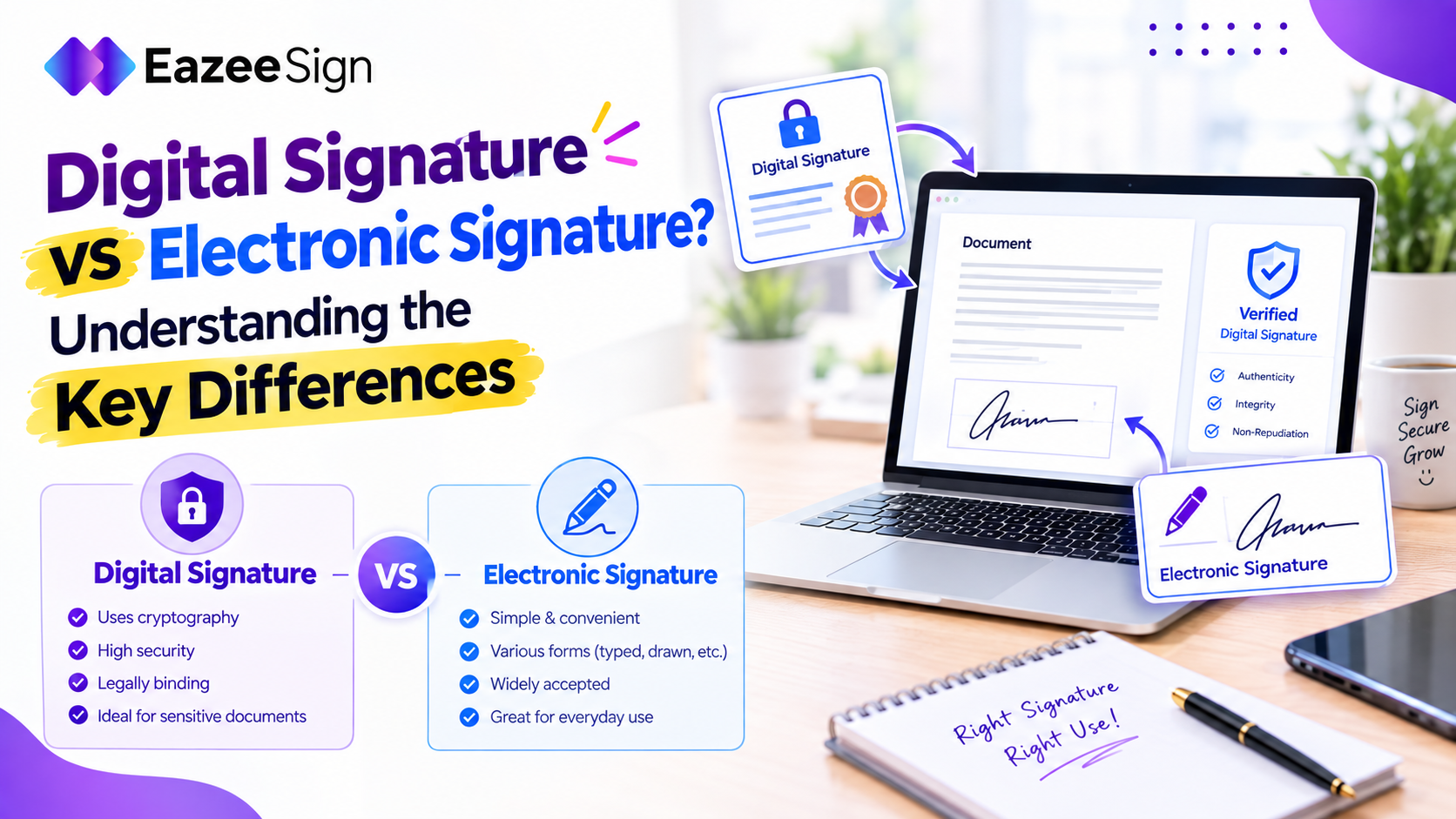
Strip away the jargon and it comes down to two different questions. An electronic signature answers: did somebody agree to this? And A digital signature answers something else: can this document be proven authentic?
One is the act of signing. The other is the security layer sitting underneath that act.
Consider a lease agreement sent through EazeeSign, where a tenant types their name to accept the terms, that is the electronic signature part. If the platform also applies cryptographic verification in the background to lock the document against future edits. That is the digital signature doing its job quietly without the tenant even noticing.
When to Use Digital Signature or Electronic Signature
Electronic signatures make sense when speed matters more than heavy verification. Offer letters during hiring. Routine NDAs. Internal approvals that need to move fast and do not carry much risk if something goes slightly wrong.
Digital signatures earn their place in a different category entirely — financial transactions, high value contracts, anything being submitted to a government or regulatory body, or agreements where forgery would create real legal exposure. Basically, situations demanding airtight proof of who signed and exactly when.
A simple test helps here: imagine the document’s authenticity gets challenged six months from now. If the fallout would be minor, electronic signature is probably fine. If the fallout would be serious, digital signature is the safer bet.
Are Both Legally Valid?
Both hold up, though not identically. Indian law recognizes electronic signatures under the Information Technology Act, 2000 and the Indian Evidence Act already treats electronically signed documents as admissible in court. Digital signatures go a step further, carrying additional legal weight because of the certificate based encryption backing them.
Which is exactly why choosing compliant eSignature software is not just a convenience decision. It is closer to a risk decision one that determines whether a signed document survives scrutiny later.
Digital Signature vs Electronic Signature: Quick Comparison
| Aspect | Digital Signature | Electronic Signature |
| Purpose | Verifies authenticity, prevents tampering | Confirms intent to agree or approve |
| How it works | Cryptographic keys and certificates | Typing, clicking, drawing, or uploading |
| Security level | Very high | Depends on the platform used |
| Typical use cases | Financial, legal, regulatory documents | HR forms, contracts, approvals |
| Legally binding | Yes, strong evidentiary weight | Yes, under IT Act 2000 |
How EazeeSign Supports Digital Signature and Electronic Signature Software
EazeeSign was built around exactly this problem, the fact that businesses should not have to juggle two separate tools for two related but different jobs. Both live under one platform and teams pick whichever fits the document sitting in front of them.
Everyday agreements go through EazeeSign’s electronic signature software upload a file, add signers, drop signature fields where they belong, send it off. A few minutes, no printer or scanner anywhere in sight. Documents that need something stronger route through EazeeSign’s digital signature software instead, applying the same cryptographic standards used across financial and legal paperwork.
A few things run underneath both workflows. Every action on a document gets logged in a full audit trail. Multi party signing handles agreements with several stakeholders involved. Bulk sending pushes the same document out to a long list of recipients at once and automated reminders chase down pending signatures so nobody has to do it manually. Two factor authentication adds another layer on top and the AI features like document summaries, risk detection catch unusual clauses before anyone signs off on something they shouldn’t.
Recipients, for their part, need none of it. No account, no app, no download. Open the document in a browser, sign, done.
Final Thoughts
None of this has to be complicated. Electronic signatures app cover the everyday stuff, agreements where showing intent is really all that is required. Digital signatures step in once cryptographic proof of authenticity becomes non negotiable. Most organizations end up needing both, at different moments, for different documents — which is really the argument for one platform that handles each properly rather than stitching together two.
EazeeSign offers a free trial with full feature access so both signature types can be tested firsthand before any plan gets chosen.
Frequently Asked Questions
What is the main difference between a digital signature and an electronic signature?
Electronic signature is a general term covering any electronic method used to indicate consent, like putting in the name or clicking. Digital signature is narrower and is a certificate-based form with verification through cryptographic keys..
Is a digital signature more secure than an electronic signature?
In general, encryption and a specific private key make forgery more difficult. However, the security of an electronic signature largely depends on the medium used to deliver it.
Are electronic signatures legally valid in India?
Yes, the IT Act of 2000 recognizes electronic signatures, and the Indian Evidence Act applies to them as to any other signed documents.
Can one document use both a digital signature and an electronic signature?
It happens often. A document gets electronically signed to show intent, while a digital signature underneath locks in proof that nothing changed afterward — convenience and verification, both at once.
Is special software required to create a digital signature?
Generally, yes — software built on Public Key Infrastructure, specifically, to generate and check the cryptographic keys involved. EazeeSign handles this automatically behind the scenes, so there is no technical setup required on the user’s end.
Which type suits a small business handling routine contracts?
Electronic signatures cover most of the day to day load, offer letters, NDAs, vendor paperwork. Digital signatures make more sense for the higher stakes documents, financial records especially, or anything headed to a regulator.
Do recipients need an account to sign a document?
No account, no download. Recipients open the document through EazeeSign and sign directly in a browser.
Can eSignature software be tested before payment?
Yes, through EazeeSign’s free trial, which includes full feature access across both digital and electronic signature workflows before any plan is selected.