B-1/E-23, Mohan Co-Operative Industrial Area, Mathura Road, Delhi-110044, India


- Digital Signature Software
- 26-Aug-2026
- -
- 0 Comments
Most document workflows have the same problem. They work. Just not well enough.
A contract that takes four days when it should take four hours. An approval chain that stalls because the right person is unreachable. A compliance filing that gets questioned because the audit trail was not detailed enough. These are not catastrophic failures — they are the slow drain of operational inefficiency that compounds quietly until someone finally asks why documents take this long to move.
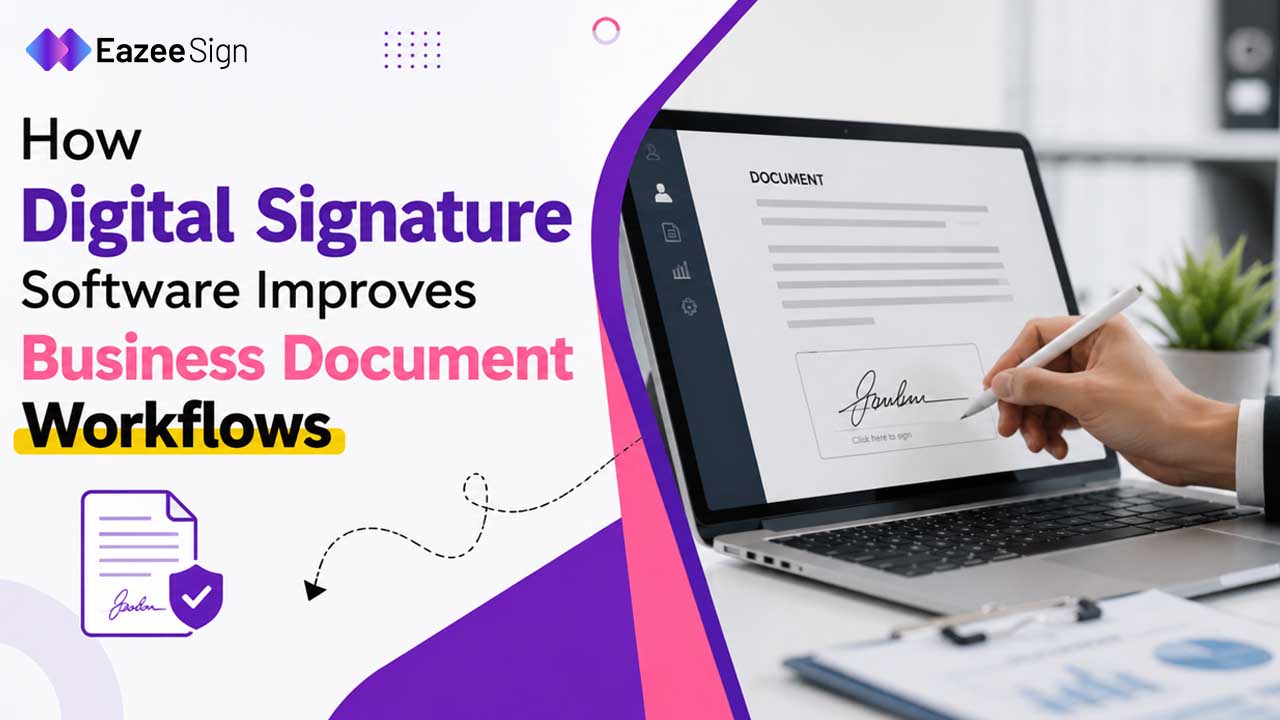
Digital signature software is where that question gets answered. Not just by digitizing signatures — but by restructuring how documents move, how approvals are enforced, and how records are maintained at every stage.
Why Document Workflows Break Down
Before looking at solutions, it’s worth understanding where the friction actually comes from.
Manual document workflows fail in predictable patterns. Version confusion — multiple people working from different drafts without realizing it. Sequence errors — someone signs before the previous approver has completed their step. Follow-up overhead — someone has to track every document, every signer, every pending action manually. And audit gaps — when something is disputed, reconstructing the approval history from email threads is slow, unreliable, and sometimes impossible.
None of these are the result of carelessness. They’re structural weaknesses in a process built around paper that hasn’t been meaningfully updated.
Digital signature software addresses all four simultaneously — not as separate fixes, but as part of a single workflow redesign.
How Digital signature software Transforms Document Preparation
The improvement starts before a single signature is applied.
AI-Assisted Document Creation
Most teams spend more time than they should starting contracts from scratch. A new vendor agreement. A revised NDA. A client proposal drafted to spec. Each one begins with a blank page, a template hunt, or a previous version that needs significant editing before it’s usable.
Digital signature software with built-in AI changes that starting point. Describe the document needed in plain language — the AI produces a ready-to-review draft in seconds. Standard clauses are included. Fields are pre-populated. The document arrives at the review stage faster, with less manual effort, and with fewer of the formatting errors that creep into manually assembled agreements.
Automatic Field Detection
Uploading an existing document — a vendor’s contract template, a regulatory form, a client’s standard agreement — used to mean manually placing signature fields, date fields, and required inputs on every page.
Digital signature software with automatic field detection identifies where signatures and dates belong within an uploaded document and suggests placements automatically. For teams processing high document volumes, that single capability saves meaningful time across a working week.
How Digital signature software Controls Approval Sequences
This is where document workflow improvement is most operationally significant.
Multi-Party Signing With Defined Sequences
A purchase order requiring sign-off from procurement, legal, and a department head — in that order. A client contract that needs internal approval before it goes to the customer for signature. An HR document that routes to the employee first, then leadership, then compliance.
Without sequence control, these workflows depend on someone remembering to enforce the order manually. That dependency fails. Regularly.
Digital signature software enforces the sequence automatically. Each signatory receives the document only when the previous step is complete. No manual routing. No missed steps. No documents signed out of order and then needing to restart.
Automated Reminders and Real-Time Tracking
Chasing signatures is one of the most time-consuming parts of document management — and one of the least valuable.
Electronic sign software handles follow-up automatically. If a signer hasn’t acted within a defined window, the platform sends a reminder without anyone initiating it. The sender has live visibility into where every document stands — sent, opened, signed, declined — from a single dashboard. Follow-up becomes targeted rather than speculative.
How Digital signature software Protects Document Integrity
Speed and efficiency matter. So does the protection behind the document.
Tamper-Evident Encryption
A scanned handwritten signature is an image. It can be separated from its document and reused without detection. There’s no cryptographic binding, no tamper detection, and no way to confirm the document wasn’t altered after signing.
Digital signature software applies cryptographic encryption at the moment of signing — locking the document’s exact state permanently. Change a single character afterward and the signature becomes invalid. The tampering is flagged immediately. That protection applies automatically to every document, without any additional configuration.
Comprehensive Audit Trails
The audit trail is what determines whether a signed document holds up under scrutiny.
A surface-level record logs who signed and when. A comprehensive one — generated automatically by properly built Digital signature software — captures the signer’s verified identity, authentication method, device type, IP address, precise timestamp for every action, and a cryptographic fingerprint of the document’s exact state at signing.
That depth is what resolves disputes without prolonged back-and-forth. A vendor claiming they never agreed to specific terms. A client disputing when a document was received. A regulatory body questioning whether a filing was altered after submission. The audit trail answers all of these — with evidence, not arguments.
How Digital signature software Supports Compliance
For businesses operating in regulated industries, compliance isn’t a feature preference. It’s a requirement.
IT Act 2000 and Aadhaar eSign
In India, Digital signature software that meets IT Act 2000 standards produces legally valid documents for commercial transactions. Aadhaar-based eSign — backed by UIDAI infrastructure — provides government-verified identity authentication for high-stakes documents: loan agreements, compliance filings, financial instruments.
Platforms that aren’t built around these standards don’t produce legally defensible signatures for documents that will face regulatory scrutiny. The interface may look identical. The legal standing is not.
Security Certifications
Independent certifications — SOC 2, ISO 27001 — confirm that a digital signature app’s data handling, access controls, and document storage practices meet recognized international standards. These aren’t self-declared claims. They’re the result of external audits that verify the security architecture is real.
For businesses handling sensitive commercial agreements, financial documentation, or personal data, these certifications are the difference between a platform that’s genuinely secure and one that describes itself that way.
How Digital signature software Scales With Business Growth
A manual document process that works for twenty agreements a month doesn’t work for two hundred.
More volume means more coordination. More follow-up. More version management. More filing. The administrative overhead scales with document count — and at some point, it consumes more staff time than the underlying work it’s supporting.
Digital signature software doesn’t scale that way. Whether a team sends twenty documents a month or two thousand, the workflow is the same. Templates handle preparation. Automation handles routing. Storage handles filing. The platform absorbs the volume without requiring proportional increases in headcount or administrative effort.
Bulk Send accelerates high-volume cycles further — dispatching the same document to dozens or hundreds of recipients simultaneously, each with their own signing link and individual audit trail. For HR teams running company-wide compliance acknowledgements or sales teams sending standard agreements to large customer lists, that capability moves from useful to operationally essential faster than most teams expect.
Why EazeeSign Delivers on Every Dimension
EazeeSign is built around all of these workflow improvements — not as separate modules, but as an integrated platform covering the full document lifecycle.
AI Document Generation and automatic field detection handle preparation. Multi-party signing with sequence control handles approvals. Tamper-evident encryption and comprehensive audit trails handle integrity. IT Act 2000 compliance, Aadhaar eSign support, and SOC 2 and ISO certifications handle legal validity and security. Bulk Send and unlimited storage handle scale.
The Digital signature software pricing is transparent — no envelope caps, no hidden add-on charges, no features gated behind enterprise tiers. Advanced analytics, custom branding, document groups, and workflow automation are included across all plans.
The result is a document workflow that moves faster, fails less often, and produces records that hold up when they need to — without requiring a separate tool for every stage of the process.
Frequently Asked Questions
1. How does electronic signature software improve document workflows?
It automates the entire signing process — routing documents to the right signatories in the correct sequence, sending reminders automatically, and storing completed records with audit trails attached. Manual coordination disappears.
2. Can electronic signature software handle complex multi-party approval chains?
Yes. Signing sequences are defined upfront and enforced automatically — each party receives the document only when the previous step is complete, with no manual handoffs required.
3. How does electronic sign software protect document integrity?
Cryptographic encryption locks the document’s exact state at the moment of signing. Any change made afterward — even a single character — is immediately flagged. The document is tamper-evident by design.
4. Is electronic signature app compliant with Indian regulatory requirements?
Yes — when the platform is built around IT Act 2000 standards and supports Aadhaar eSign. This ensures documents carry full legal validity for commercial, financial, and compliance transactions in India.
5. How does electronic signature software scale as document volume grows?
The workflow stays identical whether a team sends twenty documents a month or two thousand. Templates, automation, and Bulk Send absorb volume increases without adding administrative overhead or per-document costs.