B-1/E-23, Mohan Co-Operative Industrial Area, Mathura Road, Delhi-110044, India


- Uncategorized
- 17-Sep-2026
- -
- 0 Comments
Imagine you send a contract out for signature. It comes back a few hours later, signed, dated, done. You file it and move on with your day.
But here’s a question worth sitting with for a second: how do you actually know it was the right person who signed it?
For most of the history of business, that question barely came up. A signature was a signature. A photo ID looked like a photo ID. Nobody thought twice. Today, that quiet confidence isn’t quite so easy to justify, and anyone relying on Electronic Signature Software to run their business needs to understand why.
Why Old Identity Checks No Longer Work for Electronic Signature Software
Think about how identity used to get confirmed. You’d glance at a face. You’d compare a signature against one on file. You’d check an ID and move on. It worked because faking any of that convincingly took real effort.
That’s no longer true. Tools now exist that can generate a realistic looking face, mimic a voice from a short clip of audio, or produce an ID document that passes a casual glance. None of that requires special access or rare skill anymore. It’s become far more accessible than most people realize.
So the old habit, a quick visual check and moving on, isn’t enough on its own. Not for anything that actually matters. This doesn’t mean electronic signatures have become unsafe. It means the businesses relying on Digital Signature Software for their agreements need to think a bit more carefully about how identity actually gets confirmed.
What Digital Signature Software Verification Means for Everyday Contracts
Here’s where a lot of people get nervous unnecessarily. Not every document needs airtight identity verification. A newsletter signup, an internal acknowledgment form, a routine confirmation, these carry low risk if something goes slightly wrong. Sending them to a verified email address is generally enough.
The documents that deserve more attention are the ones with real consequences attached. Loan agreements. Leases. Insurance claims. Vendor contracts involving real money. High value NDAs. For these, matching your signature process to the actual stakes of the document matters more than treating every agreement the same way.
This is really a question of proportional trust. Save the heavier verification steps for the moments that call for them, and let routine paperwork move quickly the way good Electronic Signature Software is supposed to let it.
Why Digital Signature Verification Is Only Half the Story
Here’s something people tend to overlook. Confirming identity at the moment of signing solves one problem. It doesn’t solve what happens after.
Imagine a document gets signed properly, verified correctly, everything above board, and then someone quietly edits a clause a week later. Or a signer later claims they never agreed to the terms at all, hoping nobody can prove otherwise. Both of these are real risks, and neither one gets caught by identity checks alone.
This is exactly why an audit trail matters as much as the signature itself, arguably more, and it’s a core reason document security depends on the underlying Digital Signature Software, not just the signature step alone.
How EazeeSign’s Electronic Signature Software Protects You with Audit Trails
Every document signed through EazeeSign’s Digital Signature Software generates a full audit trail automatically. No setup required, no extra step to remember. It happens in the background, every single time.
Here’s what that record actually captures. Who opened the document and when. Which device and location the signature came from. The exact timestamp of every action taken, from the moment a document is sent to the moment it’s fully signed. And critically, whether anything about the document changed after signing was completed.
That last part is what makes an audit trail more than just a log file. EazeeSign’s Digital Signature technology relies on encryption that ties the signature mathematically to the document itself. Alter so much as a single character after signing, and the tampering becomes detectable. It doesn’t stay hidden. It doesn’t get explained away later. The document essentially defends itself.
Documents stay encrypted both while they’re being transferred and while they’re stored, so the protection doesn’t stop once the audit trail is created. And because EazeeSign follows recognized security frameworks for data handling, that protection isn’t just a claim on a marketing page. It’s something that’s been independently checked.
Why the Right Electronic Signature Software Needs Both Verification and Audit Trails
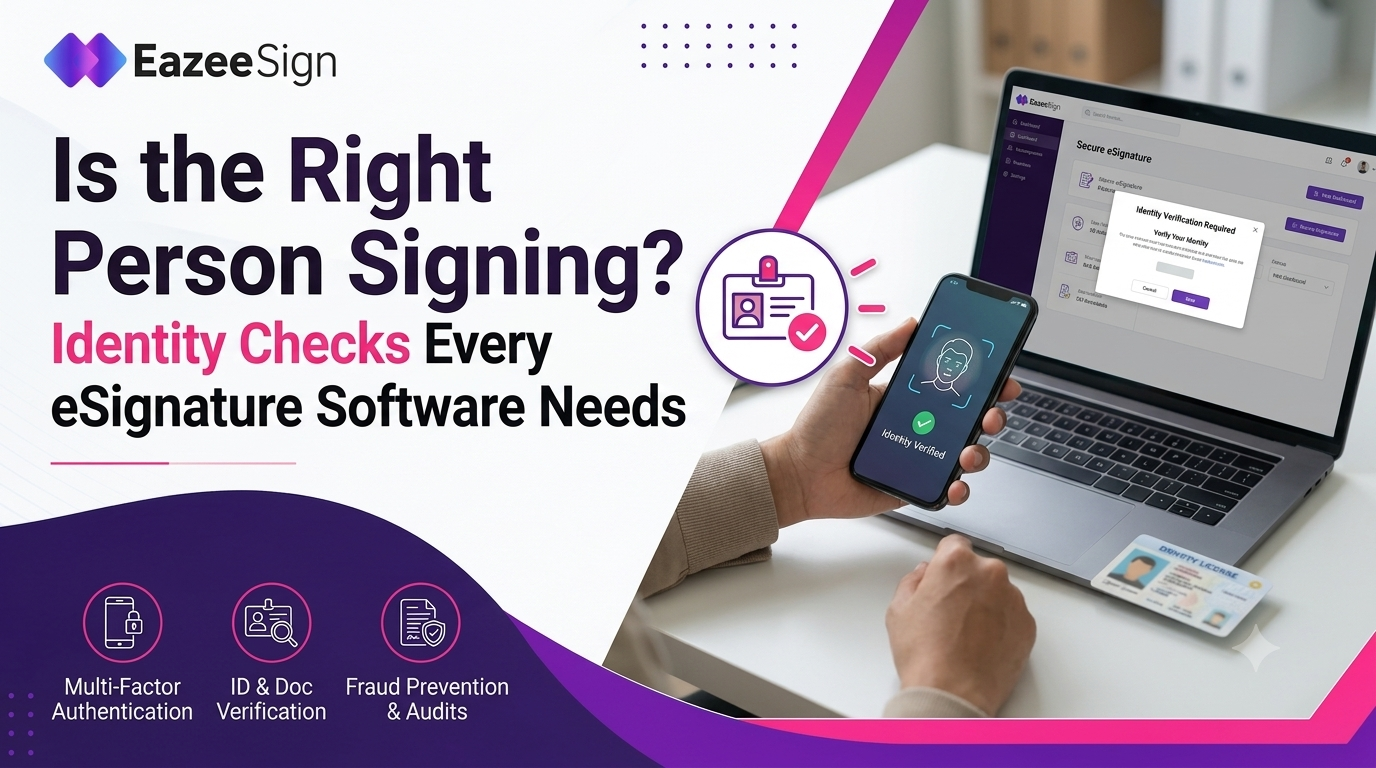
Identity verification answers one question: was this really the person who was supposed to sign?
The audit trail answers a different one: can we prove exactly what happened, and can we show nothing was altered afterward?
Neither one covers the other’s blind spot. A verified signer with no audit trail leaves you with no record if a dispute comes up later. A solid audit trail without any real identity check just means you have a very detailed record of the wrong person signing. You genuinely need both, working together, for the process to actually hold up when it’s tested.
This is the thinking behind how EazeeSign approaches its eSign app experience. Every document gets a complete audit trail by default. Verification options exist for when a document calls for something more than the baseline. Nothing about the sending and signing experience gets slower or more complicated. The protection runs quietly in the background.
Putting Digital Signature Software Verification Into Practice
A simple way to think about this: match your verification effort to what’s actually at stake.
Routine, low risk documents move fine with standard email delivery and the automatic audit trail EazeeSign already provides. Standard business agreements benefit from an added layer, like a One-Time Password or access code. High stakes agreements, the ones tied to money, property, or legal obligations, deserve the strongest checks available, paired with a complete, tamper-evident record.
None of this needs to slow your team down. Most documents will never need the heaviest option. But knowing it exists, and knowing exactly when to reach for it, is what separates a business that got lucky from one that actually built its process to hold up.
Final Thoughts
The question isn’t whether electronic signatures are trustworthy. It’s whether your process actually proves who signed and protects what they signed afterward. Identity checks confirm the right person showed up. An audit trail confirms exactly what they did, and makes sure nothing changes quietly once they’re gone.
EazeeSign builds both into the same Electronic Signature workflow, so you’re not choosing between speed and security. You get a fast, familiar signing experience, backed by a record that holds up if anyone ever asks the question this article started with: was it really the right person signing?
Frequently Asked Questions
Can someone fake their identity when signing electronically?
It’s technically possible with today’s tools, which is why matching stronger checks to higher stakes documents matters. Digital Signature Software paired with EazeeSign’s audit trail also records enough detail, device, location, timestamps, to support a document if its authenticity is ever questioned.
What exactly does EazeeSign’s audit trail record?
Who accessed the document, when they signed, what device and location they used, and whether any changes were made after signing was completed.
Does adding security steps slow down the signing process?
No. The audit trail generates automatically with no extra setup. Additional verification only adds a short step for the specific documents that need it.
Is EazeeSign’s audit trail admissible if a dispute comes up?
Yes. It’s designed to serve as a clear, timestamped record of the entire signing process, which is exactly what’s needed if a signature or a document’s integrity is ever challenged.
How do I know which documents need extra verification?
A useful rule of thumb: low stakes paperwork is fine with standard delivery, while anything involving money, property, or binding legal terms deserves an added verification layer on top of the standard audit trail.