

B-1/E-23, Mohan Co-Operative Industrial Area, Mathura Road, Delhi-110044, India


- Digital Signature Software
- 17-Apr-2026
- -
- 0 Comments
Types of Digital Signature Certificate: Digital work has quietly become the default now. Filing returns, signing agreements, and submitting documents, most of it happens online without much thought.
But when it comes to applying for a DSC, people often get stuck. Not because it’s complicated, but because the types of digital signature certificates are not always explained clearly.
You’ll see terms like Class 2, Class 3, Sign, and Encrypt. It feels like there are too many options for digital signatures, but in reality, these are just types of it and are required for different purposes for the business.
What is a Digital Signature Certificate?
Digital Signature Certificate or generally known as DSC works like your identity in the digital world. It confirms that the person signing a document is genuine.
Now this is important. A DSC is not just a typed name or a scanned signature. It runs on encryption in the background, which is what makes it reliable.
When you sign a document using a DSC, three things happen. Your identity is verified, the document gets locked after signing, and there is a record that you approved it. That combination is what gives it legal value.
This is why DSCs are used in places where trust matters, like tax filings, company compliance, tenders, and contracts.
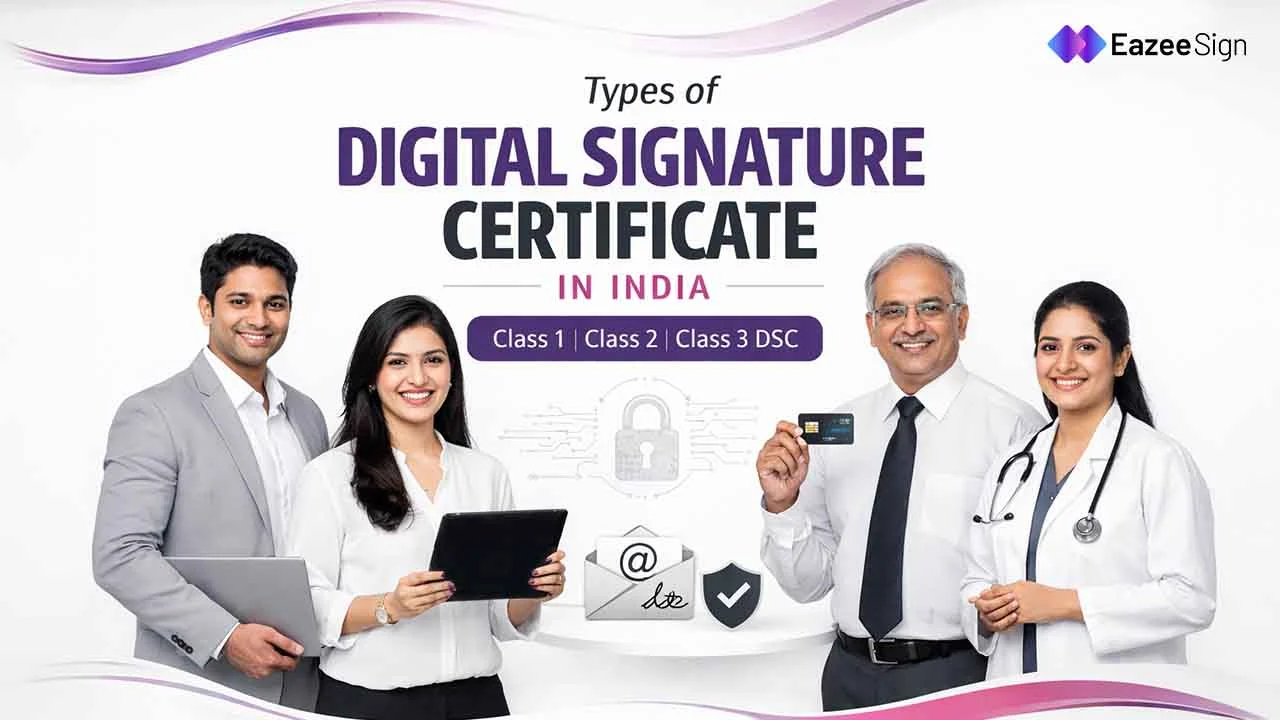
Types of Digital Signature Certificate in India
Not all DSCs are the same. They are mainly divided into two ways. One is based on the level of security, which is called class. The second is based on how the certificate is used.
Earlier, there were multiple classes in India. Now the system is simpler. Still, you’ll come across searches like DSC Class 1 2 3 difference or how many types of digital signature certificates in India, so it makes sense to understand the full picture.
Types of Digital Signature Certificates by Class
Let’s start with the class-based types. This is where most confusion usually happens.
Class 1 Digital Signature Certificate
This was the most basic type. It only verified simple details like your name and email. Nothing strong in terms of identity verification.
Because of that, it was never really used for business or compliance work. And now, it’s completely discontinued. You won’t see it being used anywhere officially.
Class 2 Digital Signature Certificate
This one was more practical and widely used earlier. It verified identity against trusted records, so it had a decent level of reliability. For a long time, professionals used Class 2 DSC for things like Income Tax filing, GST returns, and MCA work.
If you talk to someone who handled compliance a few years back, they’ve probably used this.
But as digital systems grew, this level of verification was no longer enough. That’s why Class 2 DSC has been phased out. It is not issued anymore, and even old ones cannot be renewed.
Class 3 Digital Signature Certificate
This is the one that matters today. Class 3 DSC is the highest level and currently the only valid type for most official purposes in India. The verification process is stricter, which is exactly why it’s trusted.
It usually includes Aadhaar-based eKYC, video verification, and document checks. So before issuing the certificate, the system makes sure the identity is properly verified.
Because of this, Class 3 DSC is required for high-security tasks. For example, if a company wants to participate in a government tender or file official documents, this level of verification is expected.
You’ll see it used in GST and Income Tax filings, MCA compliance, tenders, and even contract signing. At this point, it’s the standard.
Types of Class 3 Digital Signature and Their Uses
Now here’s something that often gets missed. Even within Class 3, there are different types depending on who is using it and for what purpose. This is where the actual selection happens.
Individual DSC
This is for personal use. If someone is handling their own compliance work, this is what they’ll usually need. For example, a freelancer filing Income Tax returns or a consultant signing agreements with clients would use an Individual DSC.
It carries the person’s identity, not any company details.
Organization DSC
This one is meant for businesses. Here, the certificate includes both the individual’s name and the organization’s details. So when a document is signed, it represents the company, not just the person.
This becomes important in real scenarios. For example, when a company files documents on the MCA portal or vender signs agreements, the signature should reflect organizational authority. That’s where an Organization DSC is required.
Foreign DSC
There are also cases where people outside India need to sign documents related to Indian operations.
For example, a foreign director in an Indian company may need to approve filings. In such cases, a Foreign DSC is issued so that they can complete the process remotely without being physically present.
Types of DSC Based on Function
Apart from class, DSCs are also divided based on how they are used. This is the second level of classification, and it matters when applying.
Signing DSC
This is the most commonly used type.
It is used to sign documents digitally and confirm the identity of the signer. Once signed, the document cannot be changed.
People use it for Income Tax filing, GST returns, MCA forms, and general agreements. If the requirement is mainly about signing documents, this is usually enough.
Encryption DSC
This one works differently. Instead of signing, it is used to protect data. It encrypts the document so that only the intended person can open it.
You won’t see it used everywhere. It becomes relevant when sensitive or confidential information is involved, like financial data or internal documents.
Combo DSC
This is a combination of both. It allows you to sign documents and also encrypt them. So identity verification and data protection happen together.
A common example is e-tendering. Imagine a situation when a company submit a bid for a government tender — it needs to sign the document to prove its authenticity. At the same time, the financial details are encrypted, so no one can access them before the official opening.
This ensures both fairness and security in the process.
Understanding the types of digital signature software certificate in India makes the whole process easier. It helps companies, whether they are small or large enterprises, in choosing the right certificate and avoids issues later when using it on government or business platforms.
Why Digital Signature Certificates Matter: Key Benefits
Digital signatures are not just a technical upgrade, they solve practical problems that every business deals with every day.
One of the biggest advantages of a digital signature is security because when a document is signed via a DSC, it cannot be altered, if it is, it will be detected. Even a small change breaks the signature, which makes tampering almost impossible.
Then comes speed. Earlier, documents had to be printed, signed, couriered, and stored. Now the same process takes minutes. A contract can be signed and shared instantly, even across locations.
There is also a cost benefit. No printing, no courier, no physical storage. Over time, this reduces operational effort and expenses.
But more than anything, DSCs bring trust. When someone or a user receives a digitally signed document, they already know it is verified and authentic. Understanding the types of DSC and uses helps businesses to apply the right level of security depending on the situation and use cases.
Legal Validity of Digital Signature Certificates in India
A digital signature is not just technically secure, it is also legally recognized in India.
Under the Information Technology Act, 2000, electronic records and digital signatures are given the same legal status as physical documents and handwritten signatures.
This means a digitally signed agreement can be used as valid proof, just like a paper document.
In India, the types of digital signature certificates are governed under this legal framework, which ensures that all electronic transactions remain secure and enforceable.
Role of the Controller of Certifying Authorities (CCA)
Behind every Digital Signature Certificate, there is a regulated system.
In India, this is managed by the Controller of Certifying Authorities (CCA). This authority ensures that DSCs are issued and used in a standardized and secure way.
The CCA does not directly issue certificates. Instead, it licenses Certifying Authorities (CAs) who provide DSCs to individuals and organizations.
It also defines rules for identity verification, security standards, and certificate issuance. Because of this structure, all types of DSC follow a consistent and trusted process across platforms.
Digital Signature Certificate Validity, Expiry & Renewal
A Digital Signature Certificate has a validity for specific period. In most of the cases, it is issued for 1 to 3 years. After this tenure, it get expire and cannot be used for signing any documents.
This is something which is neglected by so many users. They usually realize it only when a filing fails due to an expired DSC.
The process of renewal is generally simple but it still requires verification. It’s always better to renew a few days before the expiry to avoid disruptions.
If the certificate get expires completely, the user may need to go through the full process again. This applies to all types of digital signature certificates, including Class 3.
Why Understanding Types of DSC is Important
At a basic level, all DSCs may look similar. But in actual use, the differences matter.
For example, using a simple signing certificate where a combo certificate is required can lead to rejection in systems like e-tendering portals.
Different tasks require different levels of security. That is why multiple classifications exist.
This is where understanding the different types of DSC becomes important. It helps in selecting the right certificate from the beginning and avoids delays during compliance processes.
Special Types of Digital Signature Certificate for Specific Use Cases
Apart from general classifications available, there are some specialized types of DSCs which is designed for specific platforms or industries or specific use cases.
These are still based on Digital Signature Class 3, which is the current standard, but they are mapped for particular use cases.
DGFT / IEC Digital Signature Certificate
This type is used on the DGFT portal for import-export-related work.
Businesses involved in international trade need to submit licenses, applications, and compliance documents online. A DGFT DSC is required to authenticate these submissions securely.
ICEGATE Digital Signature Certificate
This DSC is used for customs-related processes on the ICEGATE portal.
Importers and exporters together with customs agents use the system to submit their shipping bills and declarations. The system requires secure authentication because the data includes financial information and regulatory documents.
Bulk / Document Signer Certificate
This type is used by organizations that handle large volumes of documents.
Instead of signing documents manually, systems use this certificate to sign them automatically. For example, banks generating statements or companies issuing Form 16 documents.
It improves efficiency while maintaining the same level of security across all documents.
How to Choose the Right Digital Signature Certificate
Picking the best DSC is straightforward; however, doing so can add to a certain degree of complication depending on the circumstances.
The first thing to look at is the purpose. Not every task needs the same type. For example, if someone is only filing Income Tax returns, a simple signing DSC is enough. But if the requirement involves e-tendering, a combo certificate is usually needed.
Then comes the user type. An individual working independently will need a different setup compared to someone signing on behalf of a company. In business scenarios, using an Organization DSC becomes necessary because the signature must represent the company.
Another factor is the level of security. In India, most use cases now rely on Digital Signature Class 3, so in many situations, this decision is already simplified.
It also helps to the users to check the requirements of the platform. Government portals like MCA, GST, or DGFT usually mention which type of DSC need to the user for the specific requirement. Following that rules avoids rejection.
In short, understanding the types of digital signature certificate and matching them with the use case is the safest way to choose.
Benefits of Different Types of DSC
Using the right DSC type makes a noticeable difference in day-to-day work.
A signing DSC helps complete compliance tasks quickly without manual paperwork. An encryption DSC adds an extra layer of protection when sensitive data is involved. A combo DSC brings both together, which is useful in high-security environments.
Across all types of DSC and uses, the common benefits remain the same. Faster processing, reduced manual effort, and better security.
There is also better tracking. Every signed document has a record, which helps during audits or verification.
Over time, this improves efficiency and reduces dependency on physical processes.
Real-World Use Cases of Digital Signature Certificates
Understanding theory is useful, but real examples make things clearer.
- In e-tendering, companies use a combo DSC. They sign the documents to prove authenticity and encrypt financial details so that no one can access them before the official opening.
- In company compliance, a Company Secretary uses a signing DSC to file MCA documents. This confirms that the information submitted is verified.
- In import-export businesses, a DGFT DSC is used to submit applications and licenses. Without it, many processes cannot be completed online.
- Banks and large organizations use bulk signing certificates to generate documents like account statements or Form 16 at scale. Instead of manual signing, the system handles it automatically.
These examples show how different types of digital signature certificate in India are used in practical scenarios, not just theory.
How to Choose the Right Digital Signature Certificate
Choosing a DSC is not complicated, but picking the wrong one can slow things down later.
The first thing to look at is the purpose. Not every task needs the same type. For example, if someone is only filing Income Tax returns, a simple signing DSC is enough. But if the requirement involves e-tendering, a combo certificate is usually needed.
Then comes the user type. An individual working independently will need a different setup compared to someone signing on behalf of a company. In business scenarios, using an Organization DSC becomes necessary because the signature must represent the company.
Another factor is the level of security. In India, most use cases now rely on Digital Signature Class 3, so in many situations, this decision is already simplified.
The platform requirements need checking because they help in verifying the system requirements. The required type of digital signature certificate needs to be specified by government portals which include MCA and GST and DGFT.
The procedure needs to be followed because it prevents users from facing rejection. The safest method to select digital signature certificates requires understanding their various types and comparing them with specific use cases.
How to Apply for a Digital Signature Certificate
Getting a DSC today is mostly a digital process. It does not take long, but a few steps need to be followed properly.
Application Process
The process usually begins with the selection of the appropriate certificate. This process requires the selection of Class 3 and the decision of which type to use between Sign or Encrypt or Combo and the choice of the certificate’s validity duration.
After that, the applicant fills out an online form with basic details. Once submitted, payment is completed and the verification process begins.
The documents are simple, but they need to be accurate.
Documents Required
For individuals, this usually includes:
- PAN Card
- Address proof (Aadhaar, Passport, Voter ID, etc.)
For organizations, additional documents are required:
- Company PAN
- Certificate of Incorporation or registration proof
- Authorization details of the applicant
Verification Process
This is a crucial step while signing any document digitally. It may include Aadhaar based eKYC or video verification, or document validation. In most of the cases, a short video recording is required where the applicant confirms their identity.
Once verification is completed successfully, the certificate is issued and linked to a secure USB token.



