B-1/E-23, Mohan Co-Operative Industrial Area, Mathura Road, Delhi-110044, India


- Uncategorized
- 17-Sep-2026
- -
- 0 Comments
A contract lands in an inbox needing a signature by end of day. Simple enough, except the certificate behind that signature matters more than most people realize until something gets disputed later. Not every digital signature is built the same way, and knowing the different digital signature certificate types before signing something important can save a genuine headache down the line. Most of this comes down to which electronic signature software is actually handling the signing process behind the scenes.
The Question That Decides Which Digital Signature Certificate You Need
Before getting into the technical breakdown, there’s really one question worth asking first. If this signature ever got challenged in court or by a regulator, would there be enough proof behind it to hold up? Routine internal paperwork rarely needs much. A property deal, a government filing, or a high value contract needs a lot more standing behind it.
That single question is what separates the three certificate classes below, and it’s worth returning to every time a new document type comes up in whatever eSign app your team happens to be using.
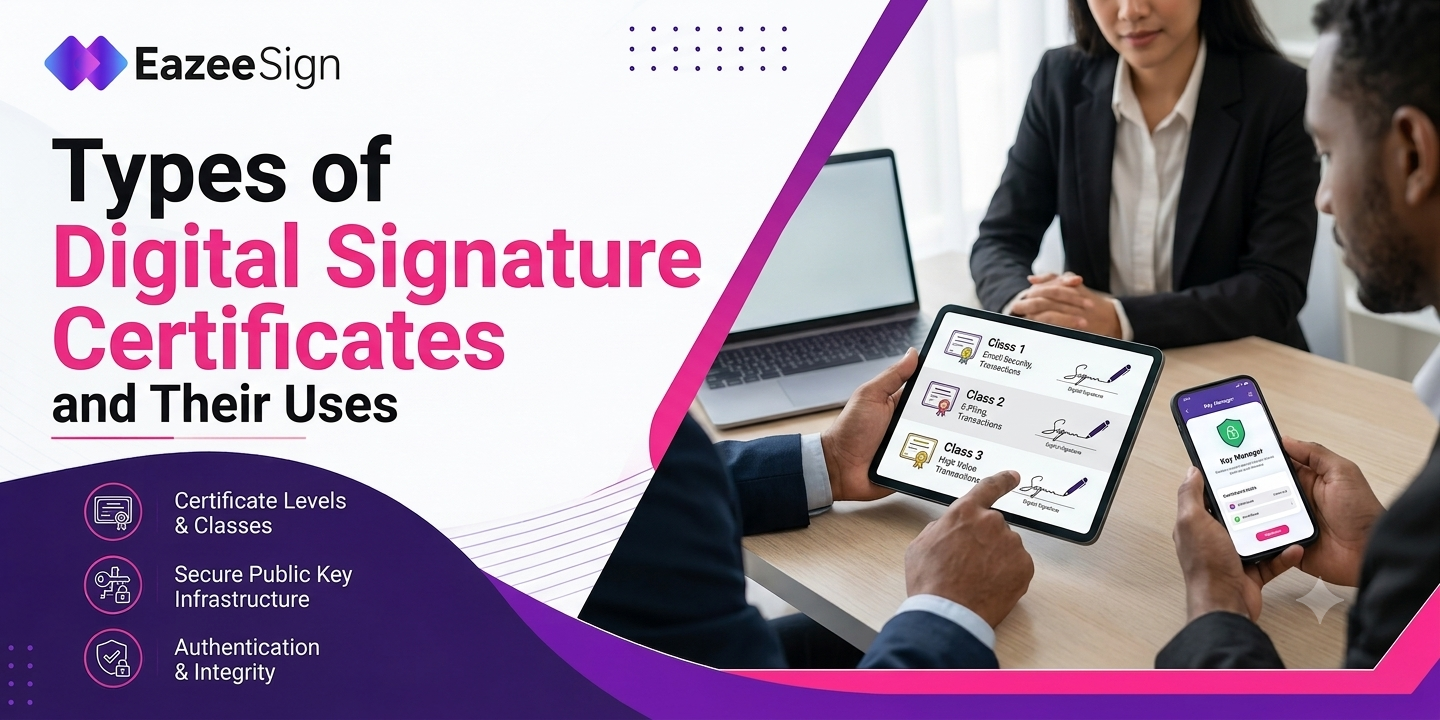
Class 1: Just Confirms an Email Address, Nothing More
This is the lightest tier available, and it only verifies that a name and email address belong to whoever requested the certificate. Nothing gets checked against any official record. Because of that, Class 1 suits low stakes situations, internal approvals, basic email confirmations, documents where both sides already trust each other and little is riding on the outcome.
It’s fast to obtain and involves almost no friction, but that same simplicity is exactly why it shouldn’t be used for anything with real financial or legal weight attached. A business using Class 1 through a basic eSign app for something like a vendor payment agreement is essentially betting that nobody will ever question it later.
Class 2: A Step Up, Checked Against Records
Class 2 certificates involve comparing a signer’s identity against a pre-verified database, think government records or financial documentation already on file somewhere. This used to be the standard for income tax filings and business registrations across several countries, including India, before regulators pushed toward stronger verification requirements.
Even in places where Class 2 has been phased out for certain filings, it’s worth understanding as a middle tier. More assurance than Class 1, without the in-person step required at the top level. Some smaller businesses still rely on digital signature software supporting this tier for internal contracts or vendor onboarding where moderate assurance is enough.
Class 3: In-Person or Video Verification Required
Class 3 sits at the top, and getting one means appearing in person, or completing an equivalent video verification, in front of a Registration Authority before the certificate is issued. It’s the strongest identity check available, and in India it’s now the standard requirement for most formal digital signing, company filings, e-tendering, anything where the government or a regulator needs real confidence in who signed.
Property transfers, high value commercial contracts, and regulated industry filings almost always call for this tier. It takes longer to obtain, but that extra effort translates directly into stronger legal footing if a signature ever gets questioned. Many banks and financial institutions now insist their electronic signature software support Class 3 specifically for loan documentation and account opening paperwork, simply because the risk involved doesn’t leave room for anything weaker.
Class 1 vs Class 2 vs Class 3 at a Glance
| Certificate | Verification Level | Best Suited For |
| Class 1 | Email confirmation only | Internal approvals, low risk documents |
| Class 2 | Checked against official records | Business filings, moderate risk agreements |
| Class 3 | In-person or video verification | Legal contracts, government filings, high value transactions |
Worth keeping this table in mind the next time a document needs signing and it’s unclear which level actually applies. When in doubt, the safer move is usually to go one tier higher than what feels strictly necessary, and a decent eSign app should make switching between tiers simple rather than a hassle.
Standard, Advanced, and Qualified: A Different Way of Slicing This
Certificate classes aren’t the only way regions categorize signature security. Many legal frameworks also split signatures into standard, advanced, and qualified tiers. A standard signature might just be a typed name or an uploaded image of a handwritten one, legally valid in most places, but offering the least protection if disputed.
Advanced signatures raise things considerably, uniquely linked to the signer, created under conditions only that signer controls, and able to detect any change made to a document after it’s signed. Qualified signatures go further still, created through a certificate issued by an accredited authority following strict checks, often carrying the same legal standing as a handwritten signature, with the burden of proof shifting onto whoever’s disputing it rather than the person who signed. A well built electronic signature software should support all three tiers without forcing a business into unnecessary complexity for routine paperwork.
It helps to think of certificate classes and these three tiers as two different lenses looking at the same underlying question, how much trust does this signature actually carry. A Class 3 certificate, for instance, generally lines up closely with what most frameworks would consider an advanced or qualified signature, since both involve strict identity verification before issuance.
How Long Does a Digital Signature Certificate Actually Last
Most certificates aren’t permanent. They typically come with a validity period ranging from one to three years, after which renewal is required to keep signing documents with the same level of trust attached. Businesses that skip renewal often don’t notice until a document gets rejected somewhere down the line, usually at the worst possible moment.
Setting a reminder well ahead of expiry avoids this entirely. For organizations issuing a high volume of signed documents regularly through a shared eSign app, tracking certificate expiry across multiple employees or departments becomes its own small administrative task worth planning for.
Picking the Right Certificate Without Overcomplicating It
Matching certificate type to document doesn’t need to be complicated once the stakes are clear. Low risk, routine paperwork rarely justifies anything beyond a basic certificate. Anything tied to real money, legal obligation, or a regulatory body deserves the stronger verification a higher tier provides.
Good electronic signature software should support this range directly, letting a business apply lighter verification where it’s genuinely fine and stronger checks where the document actually calls for it, rather than forcing every signature through one identical process regardless of what’s at stake. The right eSign app makes this switch between tiers feel like a setting change, not a separate tool entirely.
Choosing an eSign App That Actually Fits Your Needs
Beyond just certificate support, a good eSign app should also handle the everyday parts of signing well, uploading a document quickly, placing signature fields without confusion, and sending reminders automatically when someone hasn’t signed yet. All of that matters just as much as certificate strength when a business is signing dozens of documents a week.
EazeeSign is built around this kind of flexibility, backed by SOC 2 and ISO 27001 certifications and AI based risk analysis that flags unusual clauses before a document even goes out. As an eSignature software, it handles both the everyday routine signatures and the higher stakes documents that need stronger identity checks, without needing a separate tool for either.
Before Signing Anything Important
A few questions worth running through before choosing a certificate level for a document. Would the signature’s validity ever need to hold up in a dispute? Is there real money or legal obligation involved? Does a regulator or government body require a specific standard?
Answering honestly usually makes the right tier obvious. Skipping this step is how businesses end up with a signature that looks fine on paper but doesn’t actually hold up when it matters, regardless of how capable the underlying electronic signature software actually is.
Frequently Asked Questions
Which certificate class is required for income tax filings in India?
Class 3 is now the standard requirement for most formal digital signing needs in India, including many filings that once accepted Class 2.
Can a Class 1 certificate be used for a legal contract?
It’s not recommended. Class 1 only confirms an email address, offering little protection if the signature’s validity is ever questioned.
How long does a digital signature certificate stay valid?
Most certificates last between one and three years, after which they need to be renewed to keep the same level of trust attached to future signatures.
Is a qualified electronic signature the same as a Class 3 certificate?
They’re similar in spirit, both represent the highest verification tier, though qualified signatures follow specific regional frameworks like eIDAS in Europe.
Do businesses need the same certificate type for every document?
No. Good electronic signature software allows different certificate levels depending on how much is at stake with a particular document.
Can one eSign app handle both low risk and high risk documents?
Yes, a well built eSign app should support multiple certificate tiers, letting a business apply lighter or stronger verification depending on what each document actually needs.