B-1/E-23, Mohan Co-Operative Industrial Area, Mathura Road, Delhi-110044, India


- Digital Sign Apps
- 30-Oct-2026
- -
- 0 Comments
A trial window closes fast. Fourteen days, sometimes seven. Most of that time goes to clicking through menus with no plan and then a reminder email lands & a card gets charged. Nobody can say whether the tool was actually good.
A digital signature software free trial only pays off when it’s tested on purpose. Seven tests do the job. Each takes a few minutes & ends in a clear pass or fail.
Why a Digital Signature Software Free Trial Needs a Plan
Trials expire quietly. Nobody announces that day four was the best day to test the awkward stuff and by day ten the early impressions have blurred into one vague feeling about the interface.
A scorecard fixes that. Seven tests, each scored pass or fail, written down as they happen. Scores don’t fade the way memories do. They also settle arguments when more than one person gets a vote and they make a comparison between two eSignature tools far less emotional.
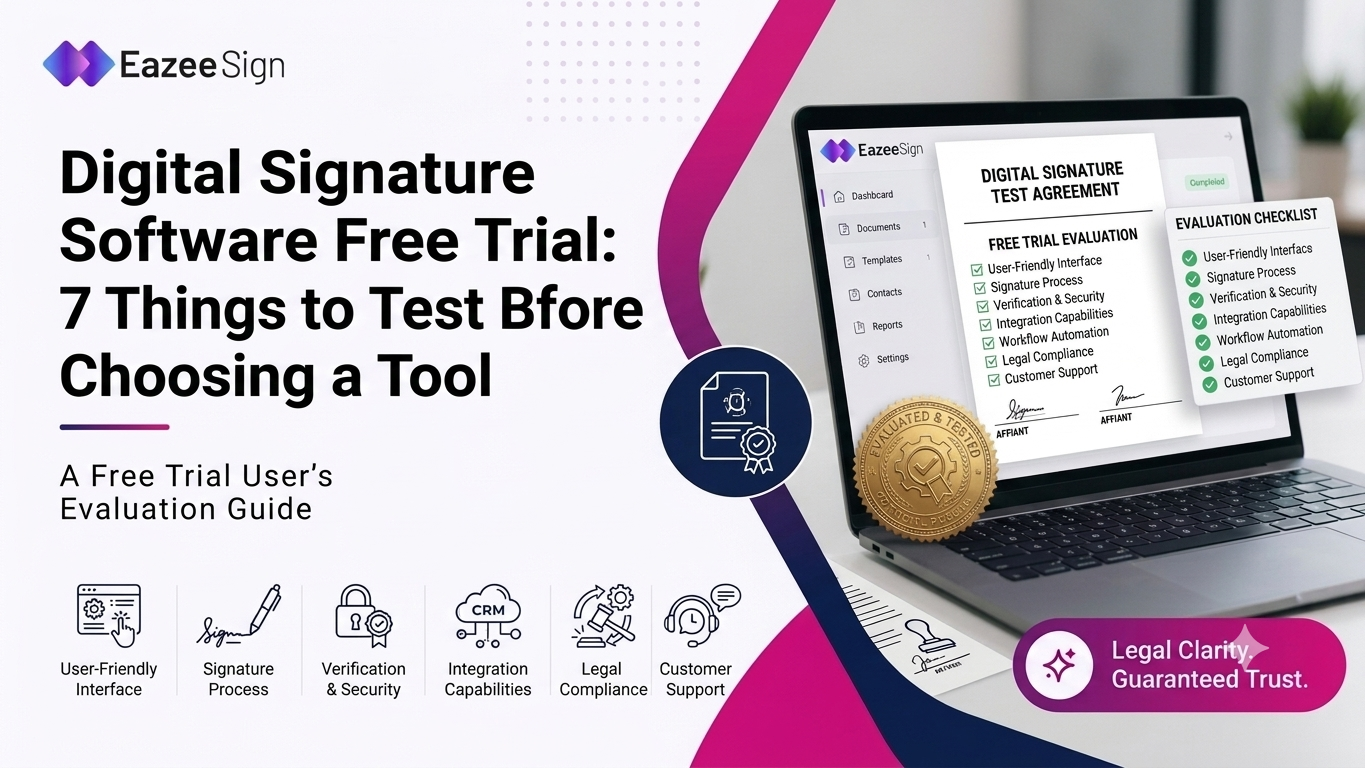
7 Things to Test During a Digital Signature Software Free Trial
1. Sending Speed
Start a stopwatch. Upload a real document, add a signer, place the fields, send. Note the total.
A simple agreement that takes more than a few minutes to send deserves a second look. Then run the same steps with a second document. Speed should improve on the repeat, since templates & saved signers exist for exactly that reason.
Pass if: the second send is noticeably faster than the first.
2. Signer Experience
Senders choose the tool. Signers judge it. A client opening a link on a busy afternoon won’t read a help page.
Send a document to someone outside the team, preferably a person who has never seen the platform. Watch for the account wall. Forced registration is where recipients quietly give upand no sender ever hears about it.
Pass if: an outside signer finishes without creating an account & without asking for help.
3. Signature Validity & Proof
Two questions sit here. What kind of signature does the platform produce and what proof does it leave behind?
Digital signatures rely on certificate based cryptography and some documents or sectors call for them. Others accept a simpler electronic signature backed by a solid audit trail which applies depends on the document & the regulation involved, so legal counsel should confirm it before any contract-heavy workflow moves over.
The audit trail is easier to test directly in electronic signature software. Finish a signing, download the record and read it like a stranger would. Timestamps, signer details & a clear sequence of actions should all be there.
Pass if: the audit record can stand on its own without anyone explaining it.
4. Security & Authentication
A signature is only as trustworthy as the check behind it. Find out how the platform verifies signers: an email link alone, a one time password, an ID check or a mix.
Then try to break it. Forward a signing link to a different person & see what happens. Open an expired link. Check whether team members can see documents they shouldn’t. & ask plainly where the data is stored, because vague answers during a trial rarely get sharper after payment.
Pass if: a forwarded or expired link gets blocked or triggers an extra verification step.
5. Tracking & Reminders
A pending document is a silent document. Good platforms make status visible at a glance: sent, opened, signed, declined, expired.
Send a document to a colleague & leave it untouched. Check whether the platform nudges them automatically and whether the sender gets notified the moment something changes. Manual chasing is where the time savings of any eSignature tool quietly disappear.
Pass if: status updates & reminders happen without anyone lifting a finger.
6. Mobile Signing
Plenty of signatures happen in taxis, corridors & waiting rooms. A desktop experience that shines tells nothing about the phone version.
Open the signing link on a phone, then try it with a weak connection. Check whether the fields are easy to tap, whether the document is readable without pinching & zoomingand whether a dedicated eSign app exists or the browser version carries the load. A signer shouldn’t need to download anything just to sign once.
Pass if: a full signing takes under two minutes on a phone, with no zooming & no dead ends.
7. Storage & Export
This test gets skipped and it’s the one that stings later. Signed agreements need to be found months or years afterwards and they need to leave the platform cleanly if the relationship ends.
Download a completed document along with its audit record. Check for watermarks or locked formats. Then try searching for it by name, date or signer, as if it were a year old. Ask what happens to stored files after cancellation.
Pass if: signed files & audit records export cleanly and search finds them fast.
How to Score a Digital Signature Software Free Trial Across Two Tools
Comparing two platforms works best when the conditions match. Same document, same signer, same week.
Give each test one point for a pass & zero for a fail. Write one sentence of evidence beside every score, such as “outside signer needed an account” or “audit record included timestamps.” Seven points is a clean sweep. Five or six is a serious contender. Below four, the tool probably isn’t worth a second week.
Weighting is fair game. A team sending contracts to external clients might double the score on signer experience. An internal HR workflow might care more about storage & export. The scorecard is a starting point, not a verdict.
Mistakes That Waste a Digital Signature Software Free Trial
Starting late. A trial begun on a Thursday loses its best days to the weekend.
Testing alone. One opinion is a hunch. Two or three make a pattern.
Using dummy files. Perfect sample PDFs hide the problems that real, messy documents expose.
Skipping the exit. Cancellation steps & data export belong in the test, not in a surprise later.
Judging by price first. A cheap tool that needs manual chasing costs more in the end.
Pick the Tool That Passed
Seven tests, a few days & a notebook are enough to turn a trial into a decision. Any platform that earns a place on the shortlist, EazeeSign included, should be able to handle that treatment without flinching.
Paper chases are fading and signing tools are only getting more capable. The teams that score before they subscribe will keep choosing well as the options multiply.
FAQs About Digital Signature Software Free Trial
What is a digital signature software free trial?
It’s a time limited period, usually 7 to 30 days, in which a team can use a signing platform before paying. Real documents get sent, signed & tracked, so the tool is judged on actual use rather than a feature list.
How long should a digital signature software free trial be?
Seven days is enough to run all seven tests if the work starts on day one. Fourteen days or more helps when several people need to weigh in or when an outside signer is slow to respond.
What’s the difference between a digital signature & an electronic signature?
A digital signature uses certificate based cryptography to verify the signer & detect any change to the document. An electronic signature is a broader term covering any method of signing online, often supported by an audit trail. Which one a document needs depends on the regulation involved, so legal advice is worth getting for high stakes contracts.
Can sensitive documents be used during a free trial?
Dummy files hide real problems, so realistic documents are the better test. Highly sensitive ones should wait until the platform’s data storage, access controls & deletion terms are clear.
Should the same tests be run on every platform being compared?
Yes. The same document, the same signer & the same week keep the comparison fair. A shared scorecard with one line of evidence per test makes the final choice much easier to defend.