B-1/E-23, Mohan Co-Operative Industrial Area, Mathura Road, Delhi-110044, India


- Electronic Signature
- 14-Sep-2026
- -
- 0 Comments
Hospitals push through an almost unbelievable amount of paperwork every day. Consent forms, prescription acknowledgments, insurance releases, employee agreements — the list just keeps going. Multiply that across dozens of patients daily and paper stops being a minor annoyance and turns into a genuine operational problem. That is exactly where eSignature for Healthcare comes in, cutting through a process that is barely changed in decades.
The hesitation a lot of healthcare organizations feel is not really about the technology. It is whether going digital actually holds up under the regulatory weight healthcare specifically carries. Turns out it does and it is fast becoming the expected standard rather than some optional upgrade.
Why Healthcare Has Been Slow to Move Off Paper
Paper’s familiar and in an industry where compliance mistakes carry real consequences, familiarity feels safer even when it genuinely is not. Plenty of clinics stick with printed consent forms purely because switching feels risky, despite paper carrying its own set of problems — misplaced documents, illegible handwriting, forms that never actually made it into a patient’s file the way they should have.
The irony is that digital signing, built properly cuts down on a lot of this risk instead of adding to it. A signed form gets archived the moment it is completed, tied to a verified timestamp, sitting somewhere it can not accidentally vanish into the wrong folder during a busy shift change.
Read More – A Guide to Different Types of Electronic Signatures
Where eSignature for Healthcare Actually Gets Used Day to Day
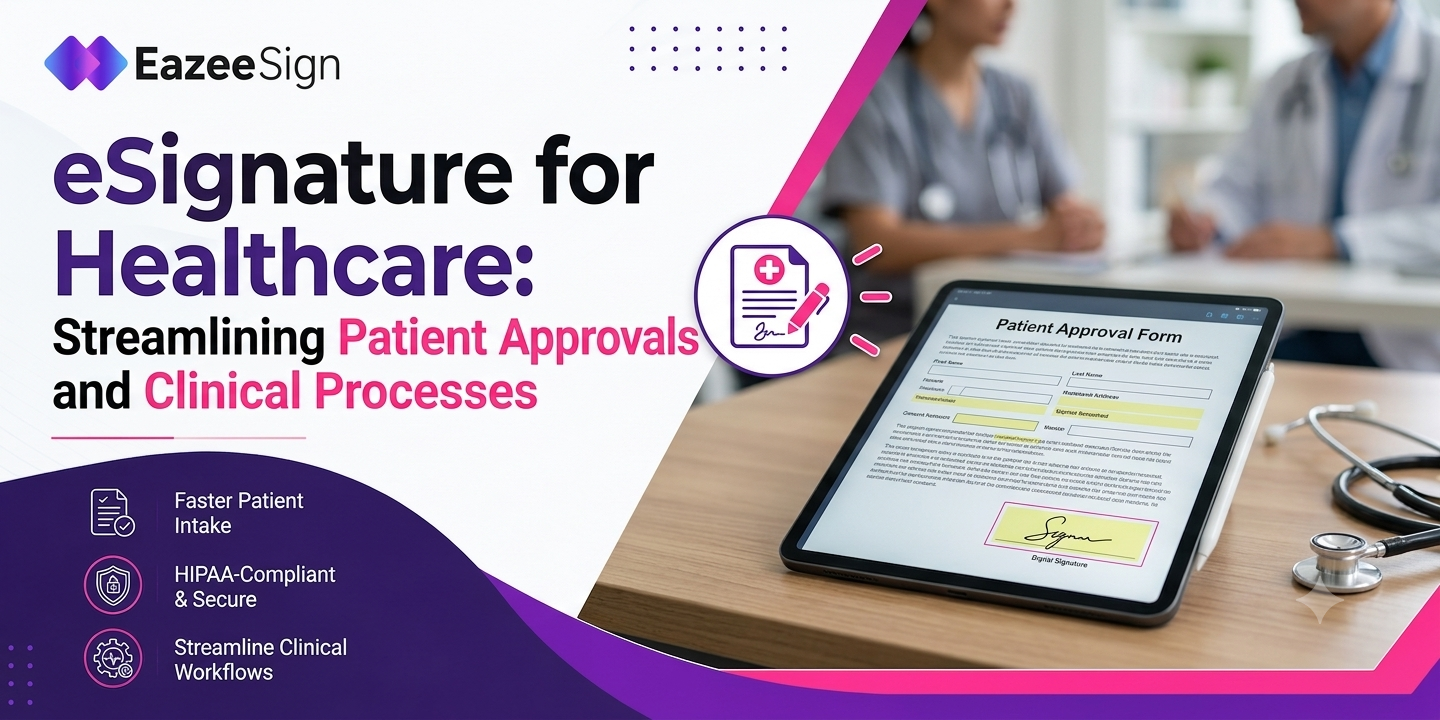
Patient consent forms are probably the biggest use case here. Instead of printing something, having a patient sign with a pen, then scanning it back into a system later, the whole thing happens right on a tablet at check-in, archived instantly once it is signed.
Beyond consent forms, plenty of other healthcare paperwork sees the same benefit. Medical records authorization, insurance claim releases, prescription acknowledgments, clinical trial enrollment forms, advance directives, procedure waivers — all of it moves faster and leaves a cleaner trail once it is handled digitally. Even the internal side of running a clinic, employee onboarding, confidentiality agreements, HR paperwork, benefits from the same shift. For a busy practice, that adds up to real time saved over the course of a single day, not just some abstract long-term efficiency gain.
What Actually Makes eSignature for Healthcare Legally Valid
This is usually the first question anyone in healthcare asks and it’s a completely fair one. In the US, electronic signature software are recognized under HIPAA aligned frameworks, as long as the platform maintains proper audit trails and access controls. The broader legal backing comes from federal electronic signature law, which treats a properly executed digital signature software with the same weight as one made with a pen.
In India, the IT Act provides that legal foundation, with mechanisms like Aadhaar eSign giving healthcare providers a recognized, compliant route for capturing digital signatures. Other regions run their own frameworks, but the common thread across most of them stays the same — clear consent, demonstrated intent and a reliable way to trace a signature back to whoever actually made it.
The Compliance Pieces That Genuinely Matter Here
Legal validity is only part of the picture in healthcare, since patient data carries its own layer of protection requirements on top of everything else. A proper eSignature setup for healthcare needs to address a few things head-on, not as some afterthought bolted on later.
Data protection agreements matter, making sure whoever is providing the signing platform is contractually bound to protect sensitive patient information the same way the healthcare provider itself is required to. Detailed audit trails matter just as much, logging exactly who signed something, when, from which device and flagging any changes made afterward. Role-based access controls round it out, making sure only authorized staff can actually request or witness a signature, rather than leaving that door open to anyone with a login.
Skip any one of these three and a healthcare organization’s digital signing setup starts looking a lot shakier than it should, even when the underlying legal recognition itself is perfectly fine.
Why Speed Matters More Here Than in Most Industries
A slow consent process isn’t just an administrative headache in healthcare, it can genuinely delay patient care. Someone waiting on a procedure while a consent form gets printed, signed by hand and scanned back in is losing time that matters a lot more here than it would almost anywhere else.
Digital signing collapses that wait almost entirely. A form loads on a tablet, the patient signs in under a minute and it’s immediately part of the record — no scanning, no filing, no risk of a paper copy getting lost somewhere between departments.
Picking eSignature Software Actually Built for Healthcare
Not every signing tool is designed with healthcare’s specific requirements in mind and that gap matters more here than in most other industries. A tool worth using should offer clear audit trails, strong encryption both in transit and storage, identity verification suited to how sensitive a document actually is and enough flexibility to handle everything from a routine consent form to something more sensitive like a clinical trial document.
Templates matter a lot in this setting too. Healthcare organizations deal with the same handful of document types constantly — consent forms, waivers, authorization releases, so reusable templates cut down setup time and reduce the odds of a required field getting missed during a hectic shift.
Where EazeeSign Fits Into Healthcare Workflows
EazeeSign provides a strong basis for healthcare organizations looking into the use of digital signing, and it is certified with SOC 2 and ISO 27001 certifications to guarantee that its security practices are validated by a third party rather than relying on its own claims. The company provides reusable templates to enable effective standardization of recurring documents, e.g. patient consent forms.
For clinics and hospitals operating under India’s IT Act specifically, this kind of setup provides the compliance backbone needed to move consent forms and clinical paperwork off paper without introducing new risk along the way.
Read More – How Safe Are Electronic Signatures?
Final Thoughts
Healthcare institutions are typically concerned about compliance as opposed to the technology behind eSignature. This hesitation is understandable as the stakes involved are high. However, the HR functions of an organization that implement eSignature properly with all the necessary certifications, audit trails, and access control methods in place reduce risks. This entails a faster, more efficient process for patients and freeing up staff time which would otherwise be wasted on unnecessary paperwork.
Frequently Asked Questions
Is eSignature for healthcare actually compliant with HIPAA?
Yes, as long as the platform maintains proper audit trails, access controls and appropriate data protection agreements covering patient information.
Can eSignatures be used for patient consent forms specifically?
Yes, patient consent is one of the most common healthcare use cases, letting patients sign digitally on a tablet or screen with the document archived instantly.
What makes an eSignature legally valid in a healthcare setting?
It generally comes down to clear consent, demonstrated intent to sign and a reliable way to trace the signature back to the actual signer, alongside a proper audit trail.
Is digital signing secure enough for sensitive medical documents?
When the software includes encryption, identity verification and detailed audit trails, digital signing is generally considered more secure than paper-based processes.
Do small clinics need the same level of eSignature security as large hospitals?
Not necessarily the same volume of features, but the core requirements, audit trails, encryption and access controls, apply regardless of a clinic’s size.
How does India’s IT Act apply to eSignature for healthcare?
The IT Act provides legal recognition for digital signatures in India with mechanisms like Aadhaar eSign offering healthcare providers a compliant way to capture signatures.