B-1/E-23, Mohan Co-Operative Industrial Area, Mathura Road, Delhi-110044, India


- Informative/Generic Topics
- 14-Oct-2026
- -
- 0 Comments
When a person needs an affidavit, people start using complicated legal jargon.
An affidavit refers to a document in which a person gives an honest summary of the truth. Courts, banks and government institutions sometimes demand affidavits in situations — when written proof is needed rather than testimony. This manual describes the process in easy-to-understand language including where electronic signature software may fit in.
Most people need affidavits only a few times in their lives but even a little misunderstanding may lead to some serious problems.
What Is an Affidavit in Simple Words
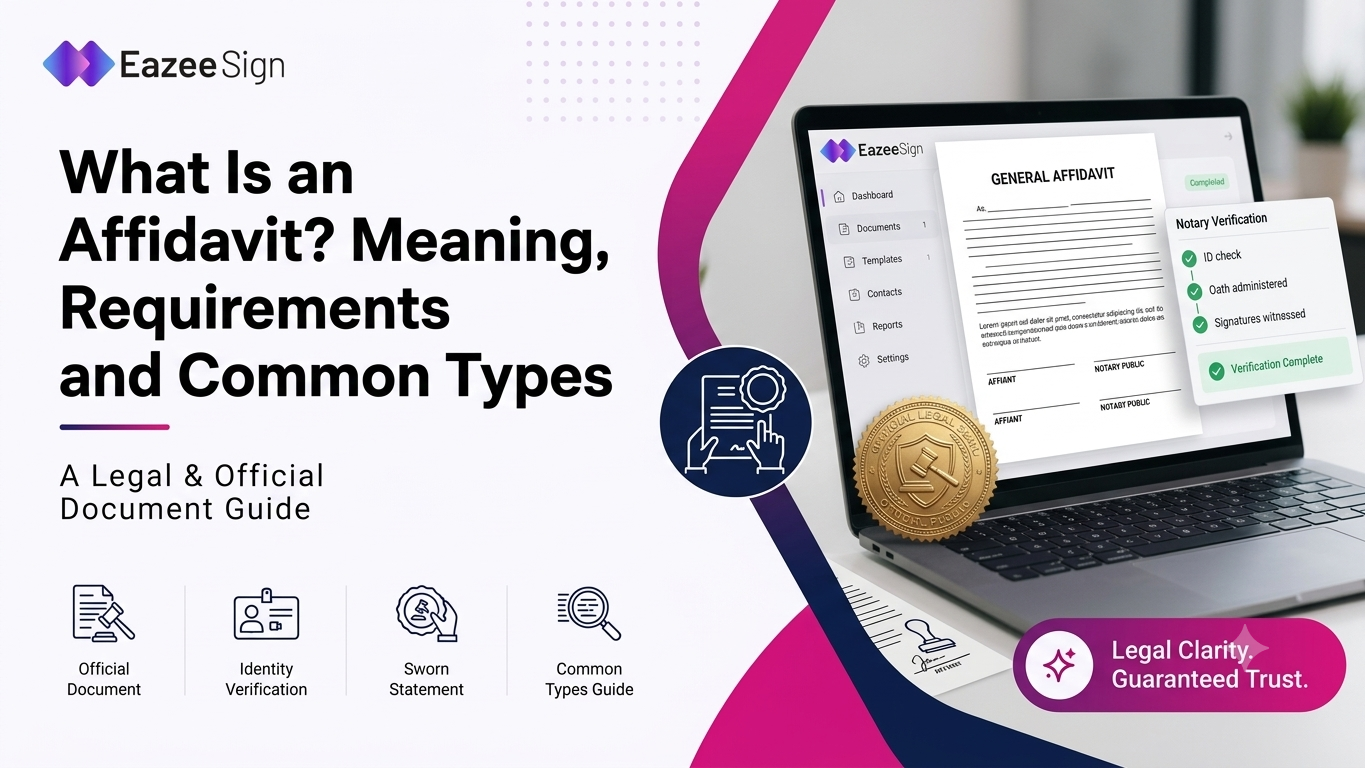
An affidavit is a sworn written statement of fact.
The person who signs this document is referred to as the affiant, and he or she guarantees that everything mentioned in the document is correct. It is similar to taking an oath in front of the court; however, in this case, the person takes the oath in writing, not orally. Typically, the signing of the document occurs in front of a notary public or any other competent authority.
That official checks the signer’s identity and confirms nobody pushed them into making the statement.
Why People Use an Affidavit
The existence of affidavits is justified by the fact that testimony is not always available and/or practical. A witness may have also moved, or the court simply may require some information confirmed right away. Thus, affidavits find their place in such cases as divorce, bankruptcy, and estate-related matters. Moreover, they provide a documented proof which is easily retrievable for all parties involved.
An affidavit can be treated as valid testimony, and it is important to know that lie in an affidavit is referred to as Oath-breaking.
Affidavit vs Declaration vs Deposition
People often confuse these terms, but in reality, there are very important differences.
A declaration is an unsworn written statement, which means that there is no need for a notary. A deposition is testimony given verbally by a witness, but not in court. An oath is a verbal promise to tell the truth, and an affirmation also serves the same purpose, but does not contain any religious aspects.
Choosing the wrong document may hamper the progress of your case or cause a document to be rejected.
What Makes an Affidavit Valid
A valid affidavit needs a few basic things in place before anyone relies on it.
The declaration should be made willingly, where no external coercion occurs. The affiant has to sign it, usually before a notary who verifies their identity and understanding of the deed undertaken. Notarization ensures more weight to the document, since the particularities of its legalization may differ according to the state and its procedures.
Checking those local rules before signing saves a lot of rework later.
Common Types of Affidavits
There are several types of affidavits, each of them covering its specific situation.
For example, an identity affidavit helps to verify a person’s identity in a banking process or in a property transaction. A service affidavit, however, proves that certain legal documents have been delivered to the person concerned, while a financial affidavit contains information concerning a certain person’s revenues, property and debts.
In addition, there exist affidavits of residence, death, domicile, marriage or heirship that are mostly used in estate matters. Knowing in advance the right type of affidavit you need will help you to meet your needs easily.
Signing an Affidavit With Electronic Signature Software
In the past, printing, signing and sending an affidavit would take several days.
With electronic signature software today the affiant can read and sign the document from a laptop or even phone in a matter of minutes. Every signature is stored together with the timestamp and the name of the person who signed it. Certain locations permit remote online notarization, which includes a secure video session covering the notary step.
Not all courts accept online notaries so checking the local guidelines is essential.
Why Digital Signature Software Adds Extra Trust
An affidavit will work only if all parties involved believe that it was left unchanged after signing.
Digital signature software allows for that trust through encryption and verification of identity of the signer. In case of document editing, changes done after signing become visible as they happen. Additionally records of the audit trail provide information about — who opened the document file when the signature took place and which device was used for completion of the process.
Common Mistakes to Avoid
Small errors can turn an otherwise solid affidavit into something useless.
Skipping notarization when it’s required is the most common slip people make. Another is including guesses or opinions instead of facts the signer knows firsthand. Vague wording, missing dates and unsigned pages cause plenty of trouble too.
A quick review by a legal professional is worth the effort for anything important.
Getting an Affidavit Right the First Time
It is a voluntary statement that can be proven by a notary and signed by the relevant individual. The kind of document used will depend on what information must be verified such as one’s identity, place of residence or ownership about property to be sold. Digital tools such as electronic signatures and digital signatures make signing much easier to do.
Make sure to check the precise regulations related to the document one needs to sign.
Frequently Asked Questions
What is an affidavit in simple words?
It’s a written statement — where a person swears the facts are true. The signer is called the affiant.
Does an affidavit need to be notarized?
Usually, yes. However, the requirements vary by state and by the type of case. Therefore, before signing anything, it is always wise to go through local guidelines.
Can an affidavit be signed with electronic signature software?
In most regions, yes. However, some courthouses and offices still have their own restrictions, so it is safe to confirm the validity of signing before.
Is digital signature software safe for affidavits?
It can be, if there is a sufficient level of security measures in place: encryption, identity verification, and audit trails can prove that the document is authentically signed and the content hasn’t been changed afterwards.
What happens if an affidavit contains false information?
Knowingly lying in one can count as perjury. Penalties vary by state and can include fines or jail time.
What is the difference between an affidavit and a declaration?
An affidavit is sworn, usually in front of a notary. A declaration is unsworn, signed under penalty of perjury and usually skips notarization.